Monday, January 28, 2019

Minimalism (the Minimal Field- Art and Polemics in the 1960s)

die fahne hoch (raise high the flag)- frank stella
1959
six mile bottom- frank stella
1960, 118x71 in.
not a rectangle, not a black square in the middle- it's a hole
lines = raw canvas showing through, the grey/white = paint
shows you exactly how it's made by copying/responding to the shape of the canvas,
doesn't transcend it, lend itself to copying, to a lesser approach
what would greenberg say about this: lacks expressive quality that elevates it
-frank stella uses very thick canvas= 3 1/2- 4 inches off the wall
-changes how you interact w it in space
-uncomfortable amount of space btwn painting & wall --> first steps of painting becoming an object
-depth pushes it from painting

donald judd:
-he doesn't make his own object, fabricators make it w his specifications
-based on own logic of construction
-designed minimalist furniture
  • judd coming out of abstract expressionist painting, what's he taking from it?
-paint on a surface, paint acts as paint
-industrial materials
-more non-objective works bc nothing is representational; it is what it is
-big, american scale
chose just one color & painted everything that color
neither painting nor a sculpture
extreme formal elements
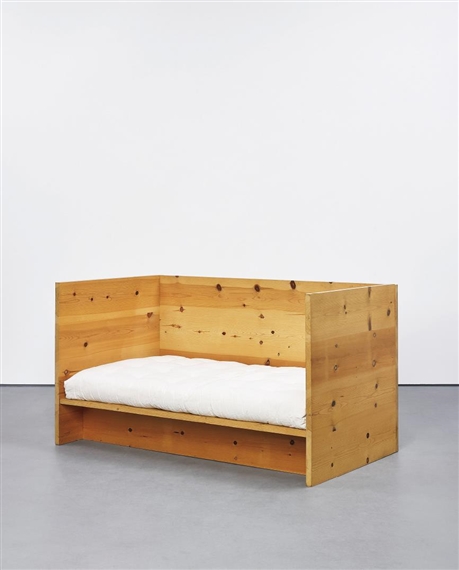
day bed- donald judd
furniture may look like sculpture &
the sculpture might look like furniture to confuse the "line"
clean & well integrated artwork in his living space
(but he was a slob & there's no dresser)
how does the minimalism of the room integrate w living? ignores the down & dirty
  • sculptures used to be on pedestals but judd takes that away & puts things flat on the ground or on the wall
  • primary structures exhibit: marker in art history
primary structures exhibit dress
robert morris
box for standing- robert morris
structure that mimics an upright coffin, he fits just right in it
sculptural (existing in space) but not sculpture
background in theatre; can build props= marriage btwn theatre & art
exists in time like a performance
continuously creates theatrical interactions
green gallery show- robert morris, 1964
objects activate/highlight the space
triangle for the corner
less of distinct objects/sculptures
don't exist in the language of sculpture, not individualized
dependent on the space
all one color, like judd
  • michael fried: if the idea is that the artist curates how the viewer sees/interacts w the work, then the artwork stops existing once viewer is not there; accuses minimalism of being theatrical
  • minimalism isn't necessarily geometric shapes but it is industrial in nature, color is inherent, new materials, big, depends on/curates viewers
lever- carl andre
bricks in a straight line coming out of the wall
primary structures
ties back to architecture
creates a low boundary
texture, color, logic of structure is inherent to material
12th copper corner- andre
steel slats in the corner
curates how you move through the space (whether you walk on it or walk around it)
  • when andre had his first international exhibit in london, the critics had a field day. they went to construction sites & compared his work w bricks there. the thing is that andre is still artful w his work. he puts it together in a certain way & they are all the same colors & purposeful
  • avant-garde practice: making things that are invisible, visible; making things that are unknowable, knowable
  • minimal work calls attention to the power of the exhibition space
Sol LeWitt:
  • LeWitt's buildings cubes
-how many ways can you go about it
-challenging to look at & understand; cool & detached
-thinking about logical conclusions & seriality, taking it as far as he can


  • LeWitt's wall drawings
-instructions on how to create the wall drawings & the curator/whoever has it follows the instructions
-looks different every time
-dependent on the person putting it up
-removes himself from the construction

Dan Flavin:
-sees himself as painter making paintings out of light/industrial materials
-judd sees these as objects
-using architectural spaces (corners, hallways)


Anne Truitt:
-doesn't fit into minimalism, post-painterly abstraction, post-minimal painting
-refers to every she makes as a painting even if it's 3D
-someone would fabricate her works & she would gesso & sand them down & put layers of acrylic paint until she had exactly what she wanted
-colors aren't inherit to material like in minimalism, she chose the colors & added on top

allusion of representational
watagua- anne truitt
  • by putting her in minimalism, it recomplicates minimalism

Wednesday, January 23, 2019

Reading: James Meyer- Minimalism; Michael Fried's Art and Objecthood; Donald Judd's Specific Objects

MINIMALISM- JAMES MEYER
what is minimalism?
-"artistic tendency whose 'organizing principles' were 'the right angle, the square, and the cube... rendered with a minimum of incident or compositional maneuvering"
-"'a movement, primarily in postwar America, towards an art...that makes its statement with limited, if not the fewest possible, resources'"
-"'last of the modernist styles'...transition between the modern and postmodern"
-Sol LeWitt: undefined art style w no limits "'to what it is and isn't'"
-"meanings altered depending on the moment or context of its use"
-two implications:
1. "minimal" = allusion to "simple" organization
2. mode of production (industrially made units --> minimum of artistic labor)
-viewers used to abstract expressionism--> criticized that work of art should be "handmade product of a subjective self"
-late 1960s/late 20th century: "general acceptance of minimalism as a leading movement"

MORRIS:
-making sculpture, not objects
-whole geometric sculpture along w readymades & casts of part objects
-suggests duchamp & johns

LEWITT:
-inspired by serial photography of eadweard muybridge
-impressed by large-scale painting
-bright hued, hand painted geometric art

JUDD:
-aspired to produce high formalist art, extend the large-scale & simple shapes of abstract expressionism into three dimensions
-specific object: art form that's neither painting or sculpture but in between
-objects & reliefs
-mural scale & wholeness
-suggests newman, rothko, & pollack

FLAVIN:
-objects & reliefs
-mural scale & wholeness
-suggests newman, rothko, & pollack

ANDRE:
-modernist sculpture
-suggests brancusi & rodin
  • larger works of art required an innovation in gallery design. smaller galleries were changed to large white rooms w high ceilings, "flexible track lighting, and shiny parquet floors" (white cube)
"Park Place" style:
-geometric shape, applied/bold color
-"represented in 'Primary Structures' by...Grosvenor, Myers, and Forakis"
-"use allusive shapes that pointed beyond the material object"

Green Gallery:

-"muted by contrast [regarding Park Place]"
-"rectilinear, undynamic, and visually bland...more austere kind of Primary Structure"
-"reductive tendency toward 'minimal' or 'ABC' art"
-"hid subject matter 'behind impassive surfaces'"

how was primary structure defined?
-LeWitt used the term structures which "implied a three-dimensional art form unfettered by associations with such traditional media as sculpture or painting...a clear, tectonic organization, a work built in a factory rather than the...artist's hand"
-the term primary was to mean a "form so basic that it did not have to be invented, so standard that it did not reflect the artist's personal decision-making"
-critic Robert Coates: the artist was more of a designer & the models were "executed by 'the lathe and milling machine operators'"
-"the minimal object embodied a contemporary, 'cool' aesthetic of refusal"
-"the most basic shapes 'offer a maximum resistance to perceptual separation'" (Morris)
-"Synthetic materials made these shapes...more legible: plexiglas and anodized aluminum made for a cleaner profile" (Judd)

Primary Structures exhibit
-in the jewish museum
-"replaced the traditional, pedestal scale of sculpture with architectural scale, muddled tones with bright or severe colors, baroque excess with tasteful austerity... simplify, to reduce"
-McShine suggested that Tony Smith and Anthony Caro were the 'father' figures of primary structure
-exhibit was meant to show a "variety of work worth looking at"; inclusiveness --> successful show
-"survey of recent work, and the art of the sixties looked different"
-had "smooth, shiny surfaces of fiberglass and sheet metal, simplified geometries, and bright color... different sense of scale"
-"sized to the viewer's body and the gallery space, removed from the pedestal and placed on the floor...explored typically architectural concerns of 'space, volume, movement, light'" (critic: Charlotte Willard)
  • fashion quickly took in minimalism around the same time as minimal art had popped up --> "rapid, dialectical mechanism of publicity and commodification propelling the New York art world of the sixties"
  • media about pop in 1963-1964 caused "realms of art, fashion, and journalism to intersect"
  • warhol, lichtenstein, oldenburg, rosenquist became art to collect --> "aesthetically pleasing or formally significant work had taken a back seat to novelty- a prizing of the new for the sake of the new"
  • "fashion and publicity drove the art world rather than serious innovation" (critic: John Canaday) --> trends were in & out
  • "ties between fine art, consumerism, and fashion as inescapable relations of twentieth-century culture" (T.J. Clark)
  • "shift from the prosperous economy of the immediate postwar years to the accelerated consumer culture of the sixties, when the development of new techniques of production and distribution...expansive mass media"
  • "during the early sixties the imagery changed. artists posed not in lonely garrets but in 'lifestyle' sections or in fashion shoots, endorsing their own work" --> "the audience for advanced work was no longer the industrial bourgeoisie of the early part of the century...in the affluent society of late fifties and sixties America, a middle class of more modest means had become concerned with its leisure and acculturation"
  • Mel Bochner: "admired how the work of...Andre and Judd suggested a radical revision of sculptural syntax- a rejection of compositional balancing for a pre-planned serial arrangement"
In-Class discussion:
-large in scale, geometric, nothing on a pedestal
-on floor, against wall, suspended from ceiling
-interacts architecturally; negotiates the space
-large white walls, tracked lighting
-exhibition spaces change to accomodate larger work
-michael fried is similar to greenberg, seeing art at its best when it's true to its material
  • judy chicago- rainbow spectrum piece
___________________________________________
ART & OBJECTHOOD- MICHAEL FRIED

michael fried: if the idea is that the artist curates how the viewer sees/interacts w the work, then the artwork stops existing once viewer is not there; accuses minimalism of being theatrical
Minimal art a.k.a. literalist art
-"belongs...to the history...of sensibility"
-"expression of a general and pervasive condition"
-"in relation both to modernist painting and modernist sculpture"
  • literalist case against painting:
-"relational character of almost all painting"
-"ubiquitousness... of pictorial illusion"

Judd & Robert Morris
-"opposed to sculpture that...is 'made part by part, by addition, composed'"
-Specific object: "assert the value of wholeness, singleness, and indivisibility"
-"critical factor is shape"
-"Morris's 'unitary forms' are polyhedrons that resist being grasped other than as a single shape... shape itself...'the most important sculptural value'"
-the shape is the object: "what secures the wholeness of the object is the singleness of the shape"
-"conflict has gradually emerged between shape as a fundamental property of objects and shape as a medium of painting"
-"modernist painting has come to find it imperative that it defeat... its own objecthood"
-Judd's remark: “The new [i.e., literalist] work obviously resembles sculpture more than it does painting, but it is nearer to painting”

object hood: "the condition of non-art"
-"the experience of literalist art is of an object in a situation...includes the beholder...heightened by 'the strength of the constant, known shape, the gestalt" our experience/reaction looking at the art
-largeness of piece --> distances viewer --> "makes the beholder a subject and the piece... an object"
-physical participation is necessary
-literalist works must confront the viewer/be placed in his way
-presence of literalist art =theatrical effect, a stage presence
-something has "presence when it demands that the beholder take it into account, that he takes it seriously"
-"the beholder knows himself to stand in an...open-ended...relation as subject to the impassive object"
-"size of much literalist work... compares fairly closely with that of the human body"
-"hallowness of most literalist work, the quality of having an inside- is...anthropomorphic (having human characteristics)
  • "hidden naturalism...lies at the core of literalist theory & practice"
  • "'I didn't think of them [i.e., the sculptures he "always" made] as sculptures but as presences of a sort.” - Tony Smith
  • "what is wrong w literalist work is not that it is anthropomorphic but that the meaning...is theatrical"
-"it is in the interest...of theatre that literalist ideology rejects both modernist painting...modernist sculpture"
-war btwn theatre & modernist painting, btwn theatrical & pictorial
  • a situation in which things/objects that you see/experience do not belong to you but your presence there makes it feel as if this experience does belong to you
-objecthood = issue for modernist sculpture (despite sculpture being 3D, resembling ordinary objects & literalist work)
-emergence of new sculptural style (David Smith as a master): "render substance entirely optical, and form, whether pictorial, sculptural, or architectural, as an integral part of ambient space- this brings anti- illusionism full circle"

Anthony Caro:
-work is more "resistant to being seen in terms of objecthood than that of David Smith"
-"individual elements bestow significance on one another...by...juxtaposition"
-"emphasis on abstractness, on radical unlikeness to nature" (Greenberg)

1. "The success, even the survival, of the arts has come increasingly to depend on their
ability to defeat theatre...need to establish a drastically different relation to its audience...For theatre has an audience...the other arts do not.. literalist art, too, possesses an audience...that the beholder is confronted by literalist work within a situation that he experiences as his... important sense in which the work...exists for him alone, even if he is not actually alone with the work at the time...one art that...escapes theatre entirely—the movies...are acceptable to modernist sensibility whereas all but the most successful painting, sculpture, music, and poetry is not. Because cinema escapes theatre...it provides a welcome and absorbing refuge to sensibilities at war with theatre and theatricality...the automatic, guaranteed character of the refuge...means that the cinema, even at its most experimental, is not a modernist art."

2. "Art degenerates as it approaches the condition of theatre...a failure to register the enormous difference in quality between, say, the music of Carter and that of Cage or between the
paintings of Louis and those of Rauschenberg means that the real distinctions...are displaced by
the illusion that the barriers between the arts are in the process of crumbling...the arts themselves are at last sliding towards some kind of final, implosive, hugely desirable synthesis. Whereas in fact the individual arts have never been more explicitly concerned with the conventions that constitute their
respective essences."

3. "The concepts of quality and value-...these are central to art...-are meaningful, or wholly meaningful, only within the individual arts...literalists have largely avoided the issue of value or quality at the same time as they have shown considerable uncertainty as to whether or not what they are making is art...Judd himself has as much as acknowledged the problematic character of the
literalist enterprise by his claim, “A work needs only to be interesting. ” For Judd...all that matters is whether or not a given work is able to elicit and sustain (his) interest. Whereas within the modernist arts nothing short of conviction...matters at all. (Literalist work is often condemned...for being boring. A tougher charge would be that it is merely interesting.) The interest of a given work resides, in Judd's view, both in its character as a whole and in the sheer specificity of the materials of which it is made"

-"central to literalist art and theory is essentially a presentment of endless, or indefinite, duration. Once again Smith's account of his night drive is relevant. The literalist preoccupation with time—more precisely, with the duration of the experience...paradigmatically theatrical"

difference between literalist work and modernist painting and sculpture:
-"one's experience of the latter has no duration—not because one in fact experiences a picture by Noland or Olitski or a sculpture by David Smith or Caro in no time at all, but because at every moment the work itself is wholly manifest. It is this continuous and entire presentness, amounting, as it were, to the perpetual creation of itself, th
at one experiences as a kind of instantaneousness: as though if only one were infinitely more acute, a single infinitely brief instant would be long enough to see everything, to experience the work in all its depth and fullness, to be forever convinced by it."
-"virtue of their presentness and instantaneousness that modernist painting and sculpture defeat theatre"
_____________________________________________
SPECIFIC OBJECTS- DONALD JUDD
  • three-dimensional work does not constitute a movement/style; not enough in common
  • use of 3D objects is an alternative to painting & sculpture
  • donald judd: organizing in space
what's wrong with painting:
-rectangular plane placed flat against the wall
-rectangle determines & limits what is on/in it; edges are a boundary
-composition reacts to the rectangle
-rectangle becomes definite form, not neutral limit
-plane is emphasized & single; relationship btwn plane of canvas & wall is specific
  • "new work obviously resembles sculpture more than it does painting, but it is nearer to painting"
what's wrong with sculpture:
-newest thing about sculpture is broad scale; materials more emphasized
-material doesn't have its own movement; simply imitates movement
-made part by part/composed
-not much contrast btwn wood & metal, not much color
-color is not important

new three-dimensional work:
-a single thing
-open & extended
-small amount of work, compared to painting & sculpture
-work's being like an object or being specific
-range is wide, nature isn't set yet
-real space --> no illusionism & "literal space, space in & around marks & colors" (like painting)
-actual space = more powerful & specific
-made according to complex purposes; "not scattered but asserted by one form"
-a work doesn't need a lot to look at
-alone, more intense, clear, powerful; not "diluted by an inherited format"
-shape, image, color, & surface are single
-use of new materials, industrial products
-new materials aren't obviously art
-form & materials = closely related
  • "the aspects of neutrality, redundancy and form and imagery could not be coextensive without three dimensions and without the particular material"
  • "a work needs only to be interesting"
  • "in earlier art the complexity was displayed and built the quality"

Post-Painterly Abstraction, Realist Trends

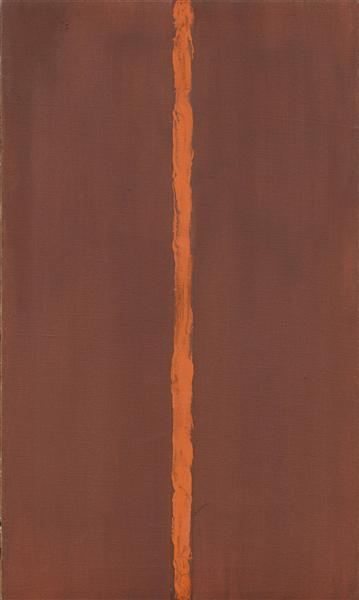
onement- barnett newman
1948, 27.25 x 16.25 in
more cerebral in approach to painting
"zipped painting"
verticality as a stand-in for humanity
simplicity of description
thinks of painting as metaphysical/bordering religious experience
conversation around humanity being vertical vs. horizontality of animal world
Greenberg's post-painterly abstraction:
-painters making paintings after that/new painters inspired/draw from newman
-blurred, loose painting, mixing paint on the palette
-painters painting like/trying to make paintings look like abstract

vir heroicus sublimus- barnett newman 1950-51
color field painting
large abstract planes of color
small vertical lines called zips
four darks in red-mark rothko
rothko chapel

mountains and sea- helen frankenthaler
1952
post-painterly abstraction
large painting, referencing landscape in title but in composition, it's far removed
hard to tell what she was looking at
unprimed canvas flat on studio floor, poured paint directly from container
canyon- helen frankenthaler
1965
title responding to the image it created (painting came first then the title)
  • Greenberg uses Helen Frankenthaler as a bridge between Rothko & Pollack (painters in 1960s)- color from Rothko, horizontal work from Pollack
whirl- kenneth noland 1960
concentric circles, geometric
no color mixing
shoot- noland 1964
triangular, no color mixing, geometric, symmetrical
big scale 103 x 126, extremely flat
compare to mondrian's linearity or cezanne's bathers in triangularity
cleopatra flesh- jules olitski
1962
height of modernist painting (greenberg)
patutsky in paradise- jules olitski
high powered spray guns on canvas = seamless layers of sheer color
1966, 115x161
flow, color just exists as color- no shape
capture effect of pure color in air (defying limits of 2D canvas)
patutsky references "prince patutsky", olitski's nickname from stepfather
saraband- morris louis
1959, acrylic resin, 101x149
pouring paint & manipulates canvas, removes brush, gravity does the work for him
color is affected by each other
greenberg sees this as the true endpoint of the modernist avant-garde project
anyone can stand in front of it and understand it
delta theta- morris louis 1961
flag- jasper johns
1954, 3' 6" x 5'1"
symbol: american flag- we all know it
flat, geometric
applique newspaper & encaustic wax to build up/layer surface on panel
target w four faces- jasper johns
1955
following "rules" by making it geometric but has texture & is referential
compare w noland's whirl
weird elements at top- bottom of faces
  • greenberg emphasizes object
  • jasper johns emphasizes maker
marilyn diptych- andy warhol
1962
what makes a warhol a warhol is him & his personality
bed- robert rauschenberg 1955
employed (similar to johns) the ideas of abstract expressionism
in modernism but undercuts seriousness of it
made a painting on his bed & hangs it on the wall
abstract expressionism: paint dripping,
leaving a lot blank space to let geometry through, emphasizing surface (like leaving canvas blank)
comes w a lot of meaning already
worked horizontally & lifted it vertically but keeps it a bed
  • rauschenberg met joseph albers, john cage at black mountain
-was influenced by ideas that they exchanged w other people
-farm, cabins, classes (very strict about what kind of artwork they wanted you to make; rauschenberg was trying to make paintings that nobody has made before but albers hated it so he hid them from albers)
skyway-rauschenberg
___________________________________________
REALISM
  • naturalism: representing objects as they exist in the real world & how things act upon them
  • realism: more political, representing real life & struggles
the stonebreakers- courbet
1849
quasi-anonymous
rough landscape rendering, unpolished/crudeness quality
portrait of who gets left behind in industrial revolution
humans like machines
ominous feeling from dark background
uses local/earthy/unmodified/unromanticized colors
lack of depth, stark color contrast, print-influenced
bringing stories & life experiences of marginalized to eyes of bourgeoisie public sphere
lady agnew of lochnaw- john singer sargent
1893
naturalism
100cm x 124cm
bedroom flirty eyes
forty-two kids- george bellows
1907, 42x60 in.
uses photography as a way to create compositions & from those photographs, he abstracts everything
two girls- isabel bishop
american landscape- charles sheeler
1930, oil on canvas
scene of industrial area but very pristine
representing history & making a claim it's a truly american landscape (very cleaned up)
ignoring a lot of other factors
beautification of industry
just bc it represents industry doesn't make it realistic or naturalistic but there are elements of both
the subway- george tooker
1950
palette- red blue okra
subject: woman right in the center, biggest; only one given humanity
many men; she looks scared, nobody is actually looking at her
she is boxed in by the architecture
psychology- anxiety (?)
subway: product of industrialized, new economy
opposite of american landscape which beautifies; this one makes it creepy
bars make it seem like jail
-professor argues as realism
-when writing about art, literally describe what you see
the terrace at vernonnet- pierre bonnard
1920-39, oil on canvas
same time as mondrian & malevich
 more focused on arbitrary colors, atmospheres w/in painting of every day life
can be symbolic
sense from paintings is that he's responding to composition as much as he is to the out there
every part of painting is important but instead of breaking into geometric forms, it refers to natural world
woman w a red umbrella seated in profile- henri matisse
1919-1921, oil on canvas
flat, color, investing just as much energy
portrait of a young man- elaine de kooning (de kooning's wife)
representation of something that already exists in the world
but still responding to the canvas in the making rather than representing the person
blue brushstrokes repeated in figure & background = acts to flatten
weird rendering of face gives it a little of depth but blue flattens
brushiness of yellow & green
making pieces of modernism & approaching it differently than avant-garde
o'hara nude w boots- larry rivers
1954, 8 ft. tall
self portrait in the studio- fairfield porter
1968
making art same time as olinski, judd, warhol- well aware of greenberg
approaching modernism differently- representational, referring back to the real world
similarities: focus on every corner of painting, every bit is important
big paintings, about life size= american scale
under the elms- porter
1971-72
replicating real world but not in naturalistic way
highlighting shape & color, existing together
2 main components: landscape/background & figure = basic principle
background: beautiful cool blues & greens & yellows, speckled throughout,
almost flattens it even though he creates sense of depth
figure is very pink compared to very cool background
replicates the way the light hits the figure & the background, equality of background & foreground
aline by the screen door- fairfield porter
1971
green vs. pink
artist is individual observer
principles of abstraction & modernist painting & applying to every day life

easter (1958), snow (1958), columbus day (1967)- fairfield porter
-same view, same tree, same houses
-extended relationship w something, coming back to it
-conservative notion of observer & artist, still rooted in reality
-he's mediating the images

  • warhol- disjointed observer, observes through mediated images
night fall- jane freilicher
2006
flowers on windowsill
early new york evening- freilicher
1954
quality of painting changes
elements of matisse
turn focus towards domestic, represented & exist in domestic space
peonies on a table- freilicher 1954
ignoring a lot of external factors, separate from their time
professor: what's the point/pursuit? why would i expect anyone else to care? what does it have to do as a record of my time? what thought goes into this? SO WHAT? does it need to respond to the time you're living in? does it exist outside of the time- what's it do?

iced coffee- fairfield porter 1966
porter: we can enjoy the paintings as viewers but seems divorced from reality that we understand & find ourselves in. seems like he's intentionally putting blinders on to everything around him; looking at a rich guy's paintings

Saturday, January 19, 2019

Jan. 13- Jan. 19 | Week Vlog.

Reading: Fairfield Porter- Jane Freilicher

  • "weakness of traditional painting in America is that it is also provincial and imitative"
Jane Freilicher
-"painting is traditional and radical"
-"consciously imitative of the masters"
-"broad and bright, considered without being fussy, thoughtful but never pedantic"
-"the clumsiness, the blunt puppyish forms remain and mean what they meant before- a deep affection for all bumbling things"

EXPERIENCING ART:

ways to inhibit art:
-"worst and most mistaken way of manipulating art is to use it for malicious propaganda"
-"consider art as a natural phenomenon for scientific investigation"
-"think that it is a substitute for science, religion or philosophy"

sociological approach:
-"if art contributes to the progressive liberation of the poor and exploited it is good"
-"if it darkens people's minds with superstition, it is bad"

historical approach:
-"art presents an image of society at any given time"
"when it works as an art parallel to the art it attempts to illuminate"
  • professionals "present art as something to be understood" --> "the experience of art can be inhibited by the way in which it is hung, reproduced, restored and criticized"
  • "to present as an actual part of life is quite a different matter from 'understanding' it as part of society"
science + art:
-"antiempirical and authoritarian"
-"doesn't take into account that art, whether realist or abstract... is not valuable... for the general principles... as for its unprecedentedness"
-"when art is reproduced mechanically... it is done scientifically, and the spirit of the original is almost invariably debased"
-"what counts is personal experience...what the critic can do...is to describe his experience as sensitively as possible"

Thursday, January 17, 2019

7 Rings | Ariana Grande (Official Music Video)

i literally watched the countdown to the premiere of the video SO LIKE.. WHAT JUST HAPPENED

ok i love ariana, i do. but i'll admit that i didn't necessarily love this song for it's lyrical complexity. i just liked it bc she snapped & she's saying she got the money & she gets what she wants

& the video was just wow, i didn't even know what was doing on but it was impressive

my only question is how does copyright stuff work when she's using the melody/tune of favorite things from the sound of music?

An Abundance of Katherines- John Green

whenever i read books, i always doggy-ear pages (guilty) where there's a line or quote or just some writing that i find beautiful, can relate to, or want to go back to. i basically just type up the quotes & keep them but i don't necessarily do anything w them, so i thought i could share them w y'all

i just finished re-reading an abundance of katherines by john green & here are some quotes from the book that i really enjoyed/related to/made me stop & think:

"what’s the point of being alive if you don’t at least try to do something remarkable? how very odd, to believe God gave you life, and yet not think that life asks more of you than watching TV"

"he’d meet a Katherine, and like her. She’d like him back. and then it would end"

"they want to stay friends; they feel smothered; it’s always them and it’s never you; and afterward, you’re devastated and they’re relieved; it’s over for them and just starting for you"

"she was a nice girl with a good heart who liked helping people, and none of them ever lit my heart... on fire like she did, but i just needed her so much and it never felt like enough and she wasn’t consistent and her inconsistency and my insecurity were this horrible match for each other, but i still loved her, because all of me was wrapped up in her, because i’d put all my eggs into someone else’s basket"

"how you matter is defined by the things that matter to you. you matter as much as the things that matter to you do"