Showing posts with label #notes/studyguides. Show all posts

Saturday, August 22, 2020

The Science of Well-being | How We Can Overcome Our Biases

Rethink "Awesome Stuff"
  • intentional, effortful activities can have a powerful effect of how happy we are even much more so than our genetics or much more so than our circumstances
  • stuff that we buy has this terrible feature where it's not really dynamic at all—it doesn't change at all, & it sticks around
  • think about not investing in awesome stuff as much. it doesn't make us as happy as we think. invest instead in things that are not going to stick around like experiences. they're not going to stick around. you're not going to have time to adapt to them
Leaf Van Boven and colleagues did this study: they had friends rate hearing about other people's experiential or material purchases. if you had them rate your overall impression of that person, it is higher after talking about experiences than material stuff. if you had other friends rate how psychologically well-adjusted are you, you get people to think you're much more psychologically well-adjusted if you invest in experiences than material things.
  • experiential experiences are better than material stuff bc experiences are less susceptible to social comparison
  • experiential purchases just seem to make other people happy because they include other people in a way that stuff often doesn't or just you telling people about your crazy experience can make other people happy
Thwart Hedonic Adaptation

Savoring: stepping outside of your own experience to review/appreciate it
  • allows you to notice things more --> start higher on your hedonic adaptation curve & takes you longer to go down
  • focuses you on that experience longer which helps prevent adaptation
Jose and colleagues talked to people who savor/don't savor their experiences & had them write down the things they did during that experience that may have caused them to savor/not savor it
  • things that enhance savoring:
-talk to another person about how good it felt
-looked for another person to share it with
-thought about what a lucky person you are
-thought about sharing this later with others
-showed physical expressions of energy
-laughed or giggled
-told yourself how proud you are
-thought only about the present, was absorbed
  • things that reduce savoring:
-focused on the future, when it was over
-reminded yourself it would be over soon
-told yourself it wasn't as good as you hoped
-reminded yourself that nothing lasts forever
-thought how it would never be this good again
-thought about ways it could be better
-told yourself you didn't deserve this good thing 
Kurtz and colleagues looked at savoring through taking images/pictures of the experience
  • negative: not being mindful & too focused on taking the picture that you don't notice things
  • positive: see different aspects through the photo & appreciate the experience more 
Sonja Lyubomirsky and colleagues had students replay their happy memories in their mind for 8 minutes a day, 3 days a week
  • people in the study increased their positive emotions 4 weeks later
  • revisiting the good stuff can lead to happier moments
Negative Visualization: thinking about the reverse that could have happened
  • can cause you to break out of hedonic adaptation by realizing you enjoy the things you have
  • realizing the chances/luck that you got to meet certain people or be where you are
  • pretending today was your last: thinking about losing something puts your attention on what it's like to not have that thing --> good things pop up bc you worry about losing it
Gratitude: quality of being thankful, being appreciative of the things you have

Emmons and McCullough looked at gratitude and have people write down 5 things that they're happy about in their life, things that they might be grateful for
  • if you have negative physical symptoms (being sick, things bothering you), these can go down when you're feeling grateful
  • when you're grateful, you put your body through better things (like having better health habits)
  • gratitude manipulation: being grateful affects things you wouldn't think it would
  • taking gratitude to the next level by sharing it can be even extra powerful
Marty Seligman used this intervention called a Gratitude Visit
  • if you write someone a letter about how grateful you are for them & physically give it to them can increase subjective well-being not in just how you feel but also in your personal relationships 
Barton Et Al looked at using gratitude as an intervention to fix marital problems
  • he plotted couples' communicative styles and looked at whether gratitude could help that
  • high withdrawers are the worst communicators
  • if you have a lot of gratitude, you can almost nullify the effects of the other bad things
  • people who feel grateful don't see the effects of other bad things as much in their marriage
  • having gratitude for your partner & being thankful they are there & expressing it can fix things
Grant and Gino looked at if simply thanking someone can make them work harder
  • ex. your superior at work comes in and says "thank you i appreciate your hard work"
  • they tested it with fundraisers at a university where the people fundraising was thanked by their superior in person. these people stuck around after & did beyond what they're paid to do
  • it increased work ethic by 50%
Reset Your Reference Points

Reference point: salient but irrelevant standard against which we constantly compare things

Carey Morewedge and colleagues looked at how biases affect our preferences of food
  • you predict how happy you are going to be when eating something & then they put other food in front of you (ex. sardines or chocolate)
  • they saw that having something else there can mess up your ability to enjoy this one thing
Concretely re-experiencing: go back & re-experience what your old reference point was before
  • ex. you get a job at google (yay) but a year later you're just still at google (meh). remember where you were before when you had a sucky job & wanted to work at google
  • this will switch your reference point into resetting
  • you go away & come back & see how good you have it now
Concretely observing: finding a reference point that's not as good as yours & observing what that reference point really is like
  • you have these ideas of what other things are like (if only i was doing this, if only i had that) & when you see it for real, you might like what you have even more
Strategies to stop comparison

1. Stop technique: be mindful & when you catch yourself comparing, you yell at yourself to stop

2. Practice gratitude. if you're focusing on the things you have, your attention is limited. you can't be grateful for what you have while also being jealous of what someone else has. Gratitude is the killer of envy so the more your practice it, the less likely you will make the comparisons in the first place

3. Be conscious of the kids of social comparisons you're letting in. curate the information that you get because once it gets in, you can't stop it. but you can control the kind of information you let in.

4. Take a break. Nelson and colleagues tested taking a break vs. taking no breaks
  • they had people listen to their favorite song over and over again. he said you're going to listen to that or you can listen to it with breaks. when people took breaks from it, he saw people's actual happiness 
  • if you don't have a break, there's nothing else to happen
  • he also did this with commercials on tv: if you watch something with no breaks, it gets boring but if there are commercials, you get a break & your enjoyment is higher
  • this means you should be splitting up the awesome things that you love most in life
  • pause & come back to it --> you're going to bump out of your hedonic adaptation curve
  • it's the opposite for bad things. if you're dealing with bad things in your life, don't try to break them up because you'll feel bad every time you go back to it. try to squish them all together so you don't notice as much as if you break it up.
5. Increase your variety
  • ex. you get the same flavor at an ice cream shop all the time. you keep getting it & it won't be as good. you're going to be adapted to it
  • switch things up & when you go back to it, it'll be better
  • the more you do the same thing over & over, the less variety you have, the more you're going to adapt to it & it'll be a boring reference point
  • have the good things in your life happen relatively, not frequently so you'll enjoy them more
  • space out the good things in your life & they become happier bc they increase variety

Wednesday, June 3, 2020

The Science of Well-being | Why Our Expectations Are So Bad

Annoying Features of the Mind (Cognitive Biases)

1. Our strongest intuitions are often misleading 
  • Miswanting (term coined by Tim Wilson at the University of Virginia & Dan Gilbert at Harvard): act of being mistaken about what and how much you're going to like these things in the future
  • The mind gives us intuitions about what's going to make us happy but it can be wrong
  • Why does this mis-wanting occur? What is up with our mind that it delivers to us incorrect predictions about what we're going actually like? What are the biases that caused these?
2. We judge ourselves relative to reference points which are often irrelevant and make us feel worse than we should
  • constantly judging relative a salient, but often completely irrelevant reference point 
Ebbinghaus illusion

which of the two orange circles do you think is the larger orange circle? 
-they are exactly the same size which you can see once the blue circles are gone
-the presence of these other circles on the outside (reference point blue circles) makes it so we actually don't see the circles at the same size even though they are
-we only see them relative to the circles around them
  • We constantly judge relative to other stuff out there in the world—it messes up our judgement of what the thing we really care about
  • Do we actually see these kinds of reference points messing up our happiness judgments? 
Reference Point #1: Ourselves
  • Whatever your counterfactual is, it's affecting your happiness
  • It's not what you have, it's what you think you could have had
  • Ex. How much salary do you need? What's the salary that you get your required income that would make you happy? 
  • It just goes up depending on what you were making before. You constantly bump yourself up. Our idea of a good income is not just done in absolute terms, it's done relative to some reference point
Reference Point #2: Social Comparisons
  • We care about where we stand relative to other people, even more than our own absolute level
  • Ex. You're more likely to want someone to be paid less, rather more than you. You're less happy that somebody else makes more than you, even though it doesn't affect your earnings
Solnick and Hemenway's survey: "Imagine you were to pick a job with one of two situations. Which would you prefer—"Have a job where you earn $50,000, but everyone else in your firm at your same level is only earning $25K OR a job where you are actually earning $100,000, but everyone else around you in your similar pay grade is actually earning $250,000 dollars?"
  • Over 50% of people choose having half of the income so they won't be less than others, even though the second option doubles your pay
  • We would assume that our minds would use reasonable reference points but they don't
O'Guinn and Schrum wanted to see whether people who were exposed to crazier and crazier reference points, more unrealistic standards of salaries and incomes, actually got messed up.
They found as you go up in your TV watchings, you also go up in your estimation of other people's average wealth. You also go down in your estimate of your own wealth relative to others. So the more TV you watch, the more unhappy you are with your own income.
  • Nowadays there's a very special, new set of reference points—social media
  • When making upward social comparisons, you definitely think that target is better than you
  • When you're making downward social comparisons, you don't get that same bump for yourself
  • Our minds suck at picking reference points. It just soaks in whatever reference point we get, with barely any filter. The more you can kind of force that filter on it, the better you will be
If we created a culture of social media where you gave the full picture of what it looked like then those might be yardsticks that actually didn't have these detrimental effects. You can pick your social comparison group to be way different than you. That can cause you to realize you can use the power of social comparison for good, because you're realizing that what looks bad to you is not actually that bad in the scheme of things if you use other people. The act of kind of counting your blessings is a sort of form of that and can be really powerful.

3. Our minds are programmed to adapt and ultimately get used to things 
  • We just have these minds that adapt over time and habituate
  • Hedonic Adaptation: process of becoming accustomed to both positive stuff & negative stuff, such that the effects you get from that emotionally don't work as well over time
  • Dan Gilbert (book: Stumbling Into Happiness) notes that wonderful things are especially wonderful the first time they happen but this wanes with repetition
You get everything you want and you get used to them. They become the new normal. They stop bringing you the happiness that you expect. And they reset your reference point for the future. This is one of the reasons that when we get this stuff, it doesn't make us happy.

4. We don’t realize how good we are at adapting and coping and mis-predict how certain outcomes will make us feel

Impact Bias: tendency to overestimate the emotional impact of a future event both in terms of intensity and its duration
  • We think it's better than it's going to be at the moment we get it & we think that it's going to last longer than it really does.
  • Mis-predicting the duration prevents us from taking certain actions bc it may be risky. 
  • There might be a bad outcome & w think it's going to affect us for a long time, but it doesn't.
Does the impact bias get lessened every time you have the experience? No. Every single time, you still mis-predict the next time that you're like, "this time I'm still going to be really upset" and you're just not. We don't get better at impact bias as we get more experience with it.

Focalism: we tend to think about just one thing about an events, forgetting everything else that could happen in our lives

You focus on one bad thing but a year from now, you're going to be doing many things & a lot will have happened. Your life will be filled with stuff that is not just that one bad thing. It's not going to be as bad as you think but focalism mean you ignore all of the other stuff, leading to mis-predicting.

Immune Neglect: we are sometimes unaware of the power of our "psychological immune system." We have this tendency to adapt to and cope with negative events. We're pretty resilient. We actually don't like when sucky things happen to us & our minds don't like to feel really awful so we have
lots of mechanisms for feeling better when we feel really awful. You engage in those mechanisms much more so than you realize. 

Kindness & Social Connection
  • Focus on positive practices that enhance our social lives
  • Make a habit of increasing our social connection & taking part in more random acts of kindness
  • Happy people are motivated to do kind things for others
  • Simple act of doing a random act of kindness can come with a host of positive benefits 
  • Doing nice stuff for others can increase our mood & our feelings of social connection

Monday, May 11, 2020

The Science of Well-being | Intro & Misconceptions about Happiness

G.I. Joe Fallacy
  • Mistaken idea that knowing is half the battle
  • Knowing something is not enough to actually change your behavior
  • If we really want to change our behavior, we have to change habits
Savoring
  • Act of stepping outside of an experience to review and appreciate it
  • Intensifies and lengthens the positive emotions that come with doing something you love
  • Boosts our mood:
  1. make us remember the good things in life
  2. helps thwart mind wandering, keeps us in the moment
  3. helps increase gratitude
  • Practice the art of savoring by picking one experience to truly savor each day
-Ex. nice shower, a delicious meal, a great walk outside, etc.
-Enhance savoring: sharing the experience with another person, thinking about how lucky you are to enjoy such an amazing moment, keeping a souvenir or photo of that activity, and making sure you stay in the present moment the entire time
-Make a note of what you savored
Gratitude 
  • Positive emotional state in which one recognizes and appreciates what one has received in life
  • Benefits:
  1. increases mood
  2. lower stress levels
  3. strengthens immune system
  4. lower blood pressure
  5. stronger social connection 
  • Take 5-10 minutes each night to write down five things for which you are grateful
-Revise and reconsider goals and aspirations that will not lead to improved well-being
-Practice savoring and gratitude every day for at least one week

Things we think will make us happy (but don't)
  • Understand that simply knowing is not enough to change behavior
  • Examples of what things won’t make you as happy as you think they will
Jobs
  • what we think we need actually jumps up every time we get more
  • this is a problem for kind of finding a good job that's going to give us a good salary
Money
  • psychological wealth is not financial wealth
  • Ed Diener's studies look at what the correlation is between your income and life satisfaction
-poor nation: true that as your income goes up, your life satisfaction goes up
-presumably if you're super poor, you're not actually getting your even basic needs met
-wealthy nation: not really seeing any correlation
  • David Myers: "Compared with their grandparents, today's young adults have grown up with much more affluence, slightly less happiness and in fact a much greater risk of depression and all kinds of social pathology."
  • Emotional well-being rises with your income but stops after $75,000. Why $75,000? Not really clear but they know that's kind of a plausible number at which you think money's not an issue
  • Life Evaluation: "Imagine you could evaluate your life on a ladder numbered from 0 to 10 and the bottom is the worst possible life and the top is the best." Where do you put yourself on this ladder? What's your perspective on your own life? Not, are you actually happier, actually blue, actually stressed, but your own vision of your own life
  • Even though our emotional well-being isn't going up after $75,000, we think our own evaluation of our own life is going up
  • Mismatch between how we're actually feeling & how we're evaluating our real life
  • high income doesn't actually mean happiness but it kind of makes you think that you must have a life that's happier when you're like, "I make $200,000. " When you think of that, you're like, "I must have a really good life" even though it's not actually translating to
Awesome Stuff
  • Folks in the 1940's didn't have half the awesome stuff that we buy to make our lives happier
  • science is learning is that thinking about stuff, kind of being materialistic, wanting stuff, and sort of striving to get it seems to actually make us worse off than we would be at baseline
  • materialist attitudes that wanted stuff had lower life satisfaction than non-materialists
True Love
  • certain number of people got married & they got asked are those married folks happier than the non-married folks? if they are happier, how long does it last? 
  • married people are in fact happier in that first year or two. there is this honeymoon effect where you report being happier. but sadly, after that, it goes back to baseline
Perfect Body
  • folks that lose weight, folks that are stable on their weight, & folks that gain weight—at baseline, they're about the same, but four years later, the folks that lost weight are actually in the worst category
  • they're the ones reporting the most depressed mood & it's almost like double the kinds of depressed mood that we see in other folks
  • people who'd eventually get cosmetic surgery were already worse than other folks
  • does beauty really make us happy? do these changes in beauty we think are going to make us happy, like losing weight, or changing our hair, do they make us happy?
  • these extreme changes in our looks or maybe even having these looks goals at all seems to actually reduce our well being
Good Grades
  • getting a grade higher than you expected is way less high on a happy scale than you expect
  • you're still kind of mostly happy, but not as good as you expect, not really any different from getting what you expected on getting 
  • getting lower than you expect is way better than predicted, it's not actually going to affect your happiness that much
Why we have misconceptions
  • How much do genes and life circumstances play into happiness?
-50% genetic set point for happiness
-10% effected by life circumstances
-40% controlled by actions, intentions, habits that people bring in
  • We can work hard to be happier. The problem is that we are working towards the wrong things.
  • The mind all the time is delivering to us these intuitions about what's going to make us happy, what's correct, etc. with full force, like that's the right answer, but it is just wrong.
  • In the 1940's, people aren't seeing commercials and advertisements for things on TV and on the Internet in nearly the same way as now. all those things seep in, pushes material culture
Sometimes, the things that our brain are telling us to do are either not true or lead us astray. How do we deal with that? Mindfulness and mindful noting of different thoughts. These things that you have these cravings for are really just thoughts. Thinking of them as such can cause you to take a step back & really look at whether those things are helping you.

Tuesday, May 5, 2020

Introduction to Visual Studies: Fantastic Art

Fantastic Art
  • one of the major art movements of 20th century
  • radical, reactionary, controversial, challenged what constituted as art
  • "anti-art" that gave rise to exploration of subconscious mind & other-worldly senses
  • explores the absurd, bizarre, imaginary, whimsical, grotesque, etc.
  • examination of "the other" challenges idea of abnormality
History
  • originated in 1916 as reaction to WWI & coming to a close before end of WWII in 1940
  • stressed growing interest in alternate way of living/thinking as a way to counter destruction of war & threat of developing technology
  • threatened by Futurism which embraced technology, speed, machines, violence
-Fantastic artists felt robbed of their individuality
-needed to save it through personal interpretations of imagination, emotion, instinct 

Fantastic art has 2 unique styles

Dadaism (1916–1923)
  • Zurich, Switzerland, reaction to WWI
  • artists denied conventions of world, opposed accepted norms
  • promoted absurdity, nihilism, irrationality
  • called for deliberate chaos & randomness to reflect senselessness of war
  • strove to stop violence as well as traditional art/culture through radical creations & behavior
  • anti-art: stood against things that were beautiful
  • called for rebellion against society's principles which were believed to contribute to the war
  • explored the naive or childlike nature of art

Surrealism (1924)
  • grew out of the chaos & nihilism of dada --> interest in dream world
  • explored realm of imaginary & unreal
  • explored states of unconscious mind 
  • artworks were more positive in content & purpose
  • reaction to war: encouraged people to cure themselves by tapping into unconsciousness
  • psychoanalysis
  • union of conscious & subconscious coexisting
  • "pure psychic automatism...an attempt is made to express...the true functioning of thought"
  • embraced chance, juxtaposition of ideas, forms, & meanings

Independent Artists did not want to adopt an art movement's goals or affiliations
  • portrayed what they found meaningful & important
  • inspiration stemmed from imagination, private dreams, memories, experiences
-Henry Rousseau
  • inspired by nature & belief in ghosts
  • supernatural, haunting, theatrical iconography

-Marc Chagall
  • based work on memories of his native village
  • paintings were poetic & nostalgic representations of his past
  • people/animals defying proportion & gravity
  • influenced by expressionist & cubist movements
  • refused to analyze meaning of his images, viewed them as presentations of self

-Giorgio de Chirico
  • most influence on surrealism
  • troubling, bizarre, disturbing imagery
  • reflect mood of the time characterized by social, political,  economic, industrial change
  • metaphysical paintings w symbols of ancient antiquity & modern invention
  • revealed a way of creating an alternate world by combining familiar & strange images

Human Emotion: Emotion Elicitation

Emotion processes

Reactivity: type/magnitude/duration of response to internal/external environment & have significance for personal goals

Regulation: processes by which individuals influence which emotions they have/how they experience & express them

Understanding: knowledge about whether we or other people are experiencing emotions (can we accurately detect them in ourselves & others)

Tools & Methods used to elicit emotions

Film Clips
  • Used to elicit positive, negative, neutral feelings
  • Emotion processes: reactivity, regulation, understanding 
  • Advantages: good ecological validity (dynamic, socially embedded) 
  • Disadvantages: require high cognitive demands (thematically complex & cannot elicit full array of emotions) 
Static photos
  • IAPS (international affective picture system) or Emotional faces
  • Robust elicitor of emotions
  • Emotion processes: reactivity, regulation, understanding
  • Advantages: low cognitive demand, low language demand
  • Disadvantages: limited range of emotions, human facial expressions can be exaggerated
Relived emotions
  • Recalling/trying to retrieve memories & go back in time to relive the memories as strongly as possible
  • Autobiographical memories vs. Shared memories
  • Emotion processes: reactivity, regulation, understanding
  • Advantages: personally relevant & engaging, good ecological validity
  • Disadvantages: idiographic stimuli (not standardized), high memory demand 
Dyadic Interactions
  • Interactions btwn people (differences btwn who the people are)

Human Emotion: What is an emotion?

1. Emotions motivate behaviors

  • Push us towards achieving goals
  • Help us shy away from dangers & threats

2. Emotions are a social glue

  • Bring us towards others
  • Keep us in lifelong bonds 
3. Emotions are critical to our health

  • Underlie our mental well-being
  • Promote physical well-being

Theories of emotion

ANCIENT GREECE- sees emotion in conflict w reason & rationality
Hippocrates: 4 humors (need a balance of all 4)
  1. Black bile 
  2. Yellow bile
  3. Phlegm
  4. Blood
Aristotle: Moderation principles
    Finding a balance, not having too much or too little emotion


ENLIGHTENMENT- thought more about what an emotion really is
Decartes
  • taxonomy of emotions
  • text: Passions of the soul- description of bodily causes, effects, functions
Spinoza
Hume
Darwin
  • evolutionary approach
  • emotions weren’t irrational but served a survival purpose
  • emotions evolved & were not specific to humans
William James: father of psychology
  • emotions are secondary to physiological phenomenon
  • Stimulus —> physiological response —> emotion
  • Ex. Snake —> heart racing —> fear
Cannon-Bard:
  • Physiological responses alone cannot explain emotion, they’re too slow
  • Stimulus (snake)—> subcortical brain interaction (registering what's happening)—> simultaneous of physiological response & experience/subjective quality of fear
Schacter-Singer: 2 factor theory of emotion
  • Appraisal of physiological experiences defines & determines emotional response
  • Physiological reaction —> Cognitive evaluation —> Emotion
  • Ex. Stage 1: Snake —> Physiological —> Stage 2: Cognitive Elaboration (way you think about what the physiological approach means) —> fear
Lazarus: Cognitive theory: cognition necessary for emotions to occur
  • Ex. Snake —> Cognitive thoughts about it —> Physiological —> Emotion
  • no emotion w/o cognition
Components of Emotion
  • Emotions have a valence (flavor: positive, negative, neutral)
  • Have an aboutness (about something, eliciting or intentional object, trigger)
  • Serve a purpose or function: vital to our survival, enables pursuit of goals
  • Multi-component response
-Subjective experience
-Outward display of behavior (bodily action)
-Physiological aspects (autonomic system)
What an emotion is not

Mood: long lasting state (days, weeks, months); no eliciting object (aboutness)
Feeling: subjective representation of emotion, private experience to individual
Affect: broad, all encompassing umbrella term; refers to general topic of mood, feeling, emotion
Personality trait: stable individual difference
Cognition: do not have facial expressions, not always physiological arousal

Categories of emotion

Basic/Discrete:
  • Emotions as discrete categories
  • Biologically fixed, universal
  • Basic emotions: anger, fear, happiness
  • Complex emotions: combination of basic emotions, culturally influenced & constructed
  • Theorists: Paul Ekman, Decartes, Silvan Tomkins
Dimensional:
  • Combination of several psychological dimensions
  • Emotional landscape map: Pleasant, Unpleasant, Anxiety, Boredom
  • Wilhelm Wundt, James Russell, Lisa Feldman Barrett

Tuesday, February 5, 2019

A Seismic Shift in the 1990s: Democratic vs. Conceptual Design

  • suggestion that average consumer could access design (democratic design)
IKEA poang chair, 1990s: $29
campana brothers, vermelha chair 1990s: $12,370
maskros lamp, assemble yourself
aeron chair by don chadwick & bill stumpf, 1994
easily adjusted for variety of users
unprecedented ergonomic research
was very expensive when it came out
"dotcom throne"
  • 1990s: fall of Berlin wall, Tiananmen square (crackdown on democracy), Nelson Mandela released, disillusion of USSR, exponential use of internet, etc.


  • widespread democratization; target, ikea, crate & barrel became more ubiquitous
  • making things more accessible to a wider spectrum of people
michael graves, architect designer
contributed line of work to Target
domestic products
wheelchair bound--> more aware of ergonomics
could create works that would be easier for those who needed
  • 1990s, target approached michael graves (starchitects- star architects- generally stayed away)
  • Graves became household name in democratic design

  • designers seen as fun & creating nice things, accessible; not unknowable, wild
  • rise of star designers
  • James Dyson:

target being inclusive & democractic

mcqueen = avantgarde & wild yet still worked w target
design trickling down to you & i


advertisement, not elite
fun industrial design products for all
logo has become their identity, don't need their name
inclusive, societal change
anna sui billboard in times square
took it down & created limited edition handbag ($29.99) as to not contribute plastic to environment
target is major sponsor of exhibitions at cooper hewitt, national design museum
origins: 1943
major expansion
cultivated notion of you as the consumer participating in design process
ease of construction, affordability, ease of replacing
"democratic design" exhibition in Germany
bright, egalitarian
(scandinavia w socialist government)
around the time obama was president
conflates image w the campaign
backlash on the notion of disposable,
throwing away furniture bc easily replaceable, thrown into environment


design research, cambridge massachusetts --> crate & barrel, michigan
added american flair & color in Scandinavian design
crate & barrel in houston
  • products available at crate & barrel
-famous designer Karim Rashid worked w them to create affordable, modern, casual design
garbo- karim rashid, 1990s
plastic garbage can
sold it via italian manufacturing firm Umbra
instant hit, allowing consumers to buy design on the cheap
Oh! chair by karim rashid, 1990s
low cost, $39.99
simple shell & snap on legs
didn't cost a lot to ship, lightweight
  • consumption- threatening or liberating? 
-accumulating things
-putting things into environment
-what does the rise in distribution & availability really do?
  • gijs baaker & renny ramakers: droog design
-criteria was flexible, some works were mass produced, some were statements
-got rid of tyranny of 1980s black & chrome, corporate design
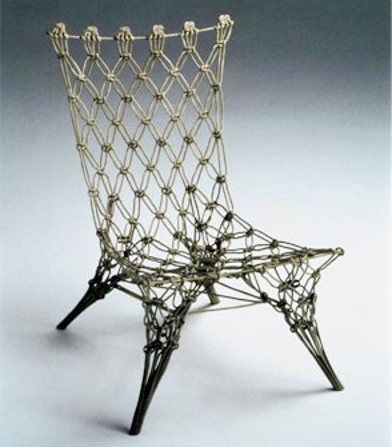
marcel wanders, knotted chair, 1996
familiar, purity, hand craftsmanship
combination of high (tech- epoxy resin) & low (references macrame)
rage chair- tejo remy, 1990s
acquired chair of what we discard
simple, readily available materials 
you can't lay down your memories- tejo remy 1990s
statement on excess consumption
critique of the glut of objects at the market place
"each drawer carries its own memories...
you have to remember what you put into each drawer"
milk bottle lamp- tejo remy
milk crates references to dutch national identity
85 lamps- rody graumans
power out of inferiority
soft urn- hella jongerius
traditional in form
vases (associate w tangible & firm objects) made of squishy material
subverts expectations via materials
vase hides nothing, the traces of its making is still there
scratches, bubbles, molding joints still visible
shows inferiority & imperfection
  • ikea approached her about vases, she reproduced them in ceramic & sold at affordable price 
drawing table
lace table- marcel wanders
 1997
epoxy resin
  • 1990s rise in phenomena of star architect & designer
-names used as marketing tools, added value
  • Philippe Stark
child's toy
  • Jasper Morrison

  • Alberto M.

  • Campana Brothers
favela (slum) chair
doesn't look comfortable, not comfortable to live in a favela
  • Karim Rashid


worldly designer artist
  • "the strength of designer culture... the popular idea that designers wield magic wands... reached a peak in the 1990s" --> retreat, some designers became more quiet & lowkey
muji design
becomes widespread in late 80s/90s
produce design that counters western world consumption
wants to be more simple, lowkey, humble, subtly of traditional japanese design
ego-less products w/o association w famous designer names
designers design anonymously, w/o name associated
out of packaging, you won't even know that the design is muji
exquisite & understated packaging design
white, simple, quiet