Monday, April 3, 2017

ch. 24 | Baroque in Italy & Spain

google drive Art History AP notes
17th century italy & spain
-Political 
  • division of nations
  • elimination of city states
  • got rid of Duchys, Republics, etc.
-Geographical
  • extensive New World exploration (expansion, taking wealth):
Spain > Mexico, Philippines
France > Canada, Asia, Caribbean
England > Canada, Asia, Australia
Portugal > South America
Netherlands > Caribbean, South Africa
  • France & England fighting over Canada
-Scientific 
  • Galileo + telescope
  • Newton + microscope
-Artistic
  • opera= union of music & theatre
  • integration/fusion of architecture, sculpture, & painting (Bernini & st. peter's basilica)
counter reformation
council of trent (1563)
the procrastination/denial of the catholic church in response to Protestantism was considered too little, too late [Martin Luther, 95 theses- 1517]
-response of the catholic church in Europe:
  • prohibition of nude images in religious art
  • art must be accessible to the general public & easy to comprehend
  • art should inspire the view to higher spiritual devotion
  • renewed veneration of Saints in art
  • megalomaniacal expansion of St. Peter's basilica
key artists:
ITALY
  • gian lorenzo bernini
  • borromini
  • caravaggio de marisi
  • artemesia gentileschi
  • pietro da cortona
SPAIN
  • zurbaran
  • diego velazquez
10 characteristics of the baroque era:
  1. relative clarity of figures & narrative elements
  2. variable light intensity via tenebrism (extreme use of light & shadow) or a transcendent source
  3. inclusive subject matter that requires the viewer to complete the meaning
  4. compositional dynamism w emphatic diagonals & recessionals
  5. polychromatic colours imply vigor & excitement
  6. dramatic body language via gaze, gesture, or posture
  7. multiple points of view (various revelations)
  8. unity of form, theme, place (full integration of elements)
  9. open compositions considered to be extraverted spaces that invite the viewer & extend beyond borders
  10. abstract theme of the fusion of matter & spirit
Bernini:

figure 24-4
Saint Peter's (Piazza & colonnade)- Bernini
break open the ovoid to welcome everyone, not just the erudite
dramatic gesture of embrace 
figure 24-5
baldacchino- bernini
bronze, 1624-1633
twisted columns, canopy in foreground
imitation of Solomon's temple
marks the high altar in the nave
& tomb of St. Peter beneath the basilica
visually bridges marble floor & vaults & dome
Throne of Saint Peter- Bernini
1657-1666
solar disk
dove in background
Constantine- Bernini
1654-1670
Constantine on horseback w robe falling down
moment of conversion/moment he converts to Christianity
curtain behind him falls, representing his ignorance
David- Bernini
marble, 1623
expansive & theatrical, dynamic
emotion-packed, dramatic
active & moving
capture split- second of maximum action
body armour at feet was offered by King Saul but
david rejected it bc he placed his faith in the Lord
we wonder what he's thinking/ his emotional reaction
figure 24-8
ecstasy of saint teresa- bernini
figure 24-6A
apollo & daphne- bernini
 apollo wants the nymph daphne, she doesn't want him
she ran away & the gods answered her prayers
by turning her into a tree
Saint Longinus- bernini
saint that speared the side of Christ
moment of conversion
mouth agape, awestruck
knot of drapery= spiritual struggle
contrapposto
chiastic pose (derives from letter from greek "chi" = "x
Blessed Ludovica Albertoni- Bernini
1671- 1674
drapery= struggle btwn body & spirit
last breath before death
momentum mori
Fountains of Bernini in Rome (first to do sculptures in fountains):
-created aural sensation (see/hear water)

Piazza Barberini
The Four Rivers

Neptune & Triton- bernini
1620
representative of dynamism of period
Neptune= God of the sea
  • expression of emotion in art: Alexander (Hellenistic) vs. Neptune (Baroque)
figure 24-9
San Carlo alle Quattro Fontane- Borromini
Undulating facade
counterpose: concave to convex
integration of exterior to interior space
entrance on corner (antithetical to Renaissance)
a lot of movement implied

figure 24-11
view of dome of san carlo alle quattro fontane- borromini
rome, italy, 1638-1641
dome of heaven- max. light into dome through windows (interior)
coffered ceiling (interior)
Caravaggio:
-influenced by the vigor & dramatic moment depicted in Bernini's works of art
-focused on Naturalism w a hint of idealism
-oblique backgrounds
-tenebrism (stage lighting- often as diagonal shafts)
-humble humans (feet)
-golden glow/flush flesh
-genres: sacred/portrait/still life/genre
  • tenebrism: exaggeration of light- chiaroscuro to max
figure 24-18
calling of saint matthew- caravaggio
tenebrism
hint of a halo
injected naturalism into representation of sacred subjects
unidealized figures
setting: tavern
stark contrast btwn light & dark
Christ summons Levi the tax collector (St. Matthew) to a higher calling
inspiration of matthew- caravaggio
1603
hint of a halo
figure 24-18B
entombment of Christ- caravaggio
stone corner coming out at you
strong diagonal lines lead the eyes
curves= recessionals= confines the shape
man looking at you to draw you in & make you feel emotions
doubting thomas- caravaggio
focal point at hole
diagonals & gaze point to it
recessionals bring movement back
repeating lines (wrinkles, hands, etc.) unify
david- caravaggio
david holding goliath's head (which was caravaggio's face)
self immolation

Diego Velazquez:
  • bodegones: scenes of daily life with strong elements of still life in the composition
-no one is idealized/romanticized/etc.
-elevates/honors status of "little people"= dwarfism
-"little people"= brought into court to teach children bc non-threatening & learned= au pair

figure 24-29
water carrier of seville- Velazquez
don diego- Velazquez
1638
beggar- Velazquez
1642
figure 24-31
las meninas- Velazquez
1656
artist (Velazquez) working on formal portrait, looking at you
reflection of queen & king
Princess Christina (sp?), dwarf, ladies in waiting
painting technique attributed to Titian of Venice
Venus & Mirror- Velazquez
1648
curtain= uncovering
prostitute?
blurry face in mirror
similar to Venus of Urbino
Venus & Cupid also in Bronzino's piece
Baroque in Northern Europe (Flanders, Netherlands, France-17th c)
  • more secular in the north
  • higher level of realism- not ideal portrait
baroque characteristics:
  • variable light
  • compositional dynamism (diagonals, recessionals)
  • extraversion- doesn't hide message, overt
  • open composition
  • crescendo moment
  • dramatic body language
  • implied movement (transformation)
key artists:
FLANDERS
  • peter paul rubens
NETHERLANDS
  • rembrandt van rijn
  • johannes vermeer 
  • pieter claesz
FRANCE
  • nicolas poussin
  • claude lorrain
  • georges de la tour
  • hyacinthe rigaud 
Peter Paul Rubens
  • specialty- depiction of human flesh
  • vigorous movement & dynamic energy
  • robust figures
  • expressive faces
  • writhing bodies
  • implied circular motion
  • dense narrative content
figure 25-2
the raising of the cross- rubens
triptych
1610-11
variable light
all gazes led to christ
horse has piercing eyes

figure 25-3
consequences of war- rubens
1638/9
circular movement
venus (?)- voluptuous
hint of blue sky = metaphor for optimism
torrent on the right = darkness
diagonals everywhere
torch- singular hope/light of reason
man w pallor of death
man w torch = look of fear
man on his back (right) = architect -> order goes to chaos, he's losing his tools
baby figures trying to cling onto maternal figures
reds create a diagonal, represent blood/sacrifice/passion/anger
propaganda piece- cautionary tale for greed (?)
Rembrandt van Rijn
  • known for feather in hat (from exotic birds) & beady eyes
  • baroque exuberance w protestant conservatism
  • beloved wife, Saskia (who died), included in several compositions
  • transcendent illuminations in compositions
  • optical clarity & precision
  • opaque hue application
  • crescendo moment narratives
  • oil paintings of the old & new testament
  • total financial bankruptcy in last decade of his life
  • sterilization from surviving child
figure 25-12
the anatomy lesson of dr. tulp- rembrandt
1632
science & discovery of human anatomy/body
figure 25-13
the night watch- rembrandt
1642
group of "good ol' boys"
group portrait
put his wife in the male-only portrait

figure 25-15
self-portrait- rembrandt
expressive face, revealing the soul
controlled use of light
nonspecific setting
figure 25-15A
self-portrait- rembrandt
1658
psychology of light
spiritual quality
Johannes Vermeer
  • optical clarity
  • symbiosis of light & color
  • meticulous detail
  • serene interiors
  • role of women
  • genre/vedute
  • 34 paintings in lifetime
  • evidence of pin hole- difficulty w perspective
  • secular subject matter
  • experimentation w camera obscura 
little street in delft- vermeer
1658
skill w depicting architecture
figure 25-1
allegory of the art of painting- vermeer
1670-1675, oil on canvas
figure 25-18C
the letter- vermeer
highly idealized depictions of social values of the burghers
figure 25-24

Louis XIV- Hyacinthe Rigaud
1701
rise of aristocracy
hair & "heels" give him height
presenting his legs- Louis invented stockings that wouldn't show his cellulite
propaganda: france is powerful
fleur de lis became decorative motif

Saturday, April 1, 2017

dear self, here's some things i don't tell you enough

you're smart, stop worrying so much about school.
you have naturally thick eyebrows, you're ahead of the curve.
you're kind, don't let anyone change that.
you have big eyes, they're cute.
you're naturally skinny, there's nothing wrong w that.
you can draw pretty well, stop doubting yourself.
you're generous, you always give give give.
you chose art as your major, that's brave.
you're always there for people, that's so great.
you always forgive, that's fearless.
you're strong, you've survived so much.
you've got some cool accomplishments, don't underrate yourself.
you're inspirational, changing a person's life is so cool.
you have great taste in music, you listen to almost anything.
you're interesting, you have so many cool things about you.
you're important, don't ever doubt that.
you're loved, i love you.


sometimes, i think about how i don't compliment my friends enough, or tell them that i love them enough, etc. but i definitely don't compliment myself enough either. i think it's important to take the time to remind yourself the good parts of who you are. so, take a minute out of your day & just give yourself at least one compliment. remind yourself that you are great, you are worthy, you are beautiful, & you are important. self-love is just as important as any other love.

Sunday, March 26, 2017

computer illustration | midterm review

  • Describe how to get a “tear off” menu?
Click and hold the Selection tool over a tool until the group of tools that resides underneath appears. Without releasing the mouse, drag to the triangle at the end of the group and then release the mouse to tear off the group.
  • What are guides? How can you make them?
Guides help you align text and graphic objects.
Create guides:
If the rulers aren’t showing, choose View > Show Rulers.
Position the pointer on the left ruler for a vertical guide or on the top ruler for a horizontal guide.
Drag the guide into position.
To convert vector objects to guides, select them and choose View > Guides > Make Guides.
  • Know the two viewing modes and when/why you use each one.
By default, Adobe Illustrator sets the view so that all artwork is previewed (CPU) in color, but when you need to edit "the bones" of an illustration, you can choose to display artwork so that only its outlines (or paths) are visible. 
  • Which mode is the fastest mode to work in? Why?
Outline mode- viewing artwork without paint attributes speeds up the time it takes to redraw the screen when working with complex artwork.
  • What are primitive shape tools? 
Tool that automatically draws the set shape.
  • Name the primitive shape tools.
Rectangle, Rounded Rectangle, Ellipse, Polygon, Spiral, and Star tool.
  • Understand modifier keys and how they change the different primitive shape tools. 
These key combinations will alter the way the object is drawn. There are 3 key combinations that can be used with the primitive shape tools:
-Shift (constrain a primitive shape to be proportionate.)
-Option (draw the selected primitive shape from the center point out.)
-Shift + Option (constrain your primitive shape to proportionate measurements while drawing it from the center point out.)
  • Understand object transformations and how you access and apply the different transformations available.
Window > Transform.
Scale
Shear
Rotate
Reflect
  • The two fundamental components of any vector object created in Illustrator are the anchor points and segments that make up the shape’s outlines or paths. 
  • Know the definition of a segment.
The simplest path you can draw with the Pen tool is a straight line, made by clicking the Pen tool to create two anchor points.
  • Know the definition of a path.
A path is the black line that appears when you draw a line in Adobe Illustrator. A path is made up of a series of points called “anchor points” and line segments between these points. 
  • The Pen tool is the most important of all the Illustrator tools because it allows the widest range of creation and control over custom paths. 
  • Know the difference between a closed path and an open path. 
Open Paths – This is a simple line with two end points.
Closed Paths – A closed shape no end points. Ex: rectangle, circle etc.
  • Know the Pen tool symbols (icons that show next to the cursor).
  • Curving segments are also known as Bezier curves. 
  • Know how to create a curved segment.
You create a curve by adding an anchor point where a curve changes direction, and dragging the direction lines that shape the curve. The length and slope of the direction lines determine the shape of the curve.
  • Know the difference between smooth points and corner points. 
Smooth point- made up of two linked control handles and help prevent the path from changing direction abruptly. both handles are in line w each other.
Corner Points- helps the path change direction. formed by line segments whose curves do not transition smoothly together.
  • Know the difference between the Selection tool and the Direct Selection tool and when to use each one of them. 
Selection tool- allows you to select text and graphics frames, and work with an object using its bounding box. 
Direct selection tool- allows you to select the contents of a frame, such as a placed graphic, or work directly with editable objects, such as paths, rectangles, or type that has been converted to a text outline.
  • All shapes comprise of anchor points and segments and can therefore be modified on a point-by-point basis. 
  • Know the two components involved when painting objects. 
Fill and stroke.
  • Know the ways you can color an object. 
Gradients, with patterns, paint brush, etc.
  • Know the definition of a stroke.
A stroke can be the visible outline of an object, a path, or the edge of a Live Paint group.
  • Understand Brushes, how you can access the different brush libraries, and how to apply them in your illustration.
Brushes let you stylize the appearance of paths. There are different types of brushes in Illustrator:
-calligraphic (strokes that resemble those drawn with the angled point of a calligraphic pen and are drawn along the center of the path.)
-scatter (disperse copies of an object (such as a ladybug or a leaf) along the path.)
-art (stretch a brush shape or object shape evenly along the length of the path.)
-pattern (paint a pattern—made of individual tiles—that repeats along the path.)
-bristle (create brush strokes with the appearance of a natural brush with bristles.) 

(Window > Brush Libraries > [library]).

You can apply brush strokes to a path created with any drawing tool, including the Pen tool, Pencil tool, or basic shape tools. Do one of the following:
-Select the path, and then select a brush in a brush library, the Brushes panel, or the Control panel.
-Drag a brush onto the path. If the path already has brush strokes applied to it, then the new brush replaces the old brush.
  • Understand the Gradient panel and how to make/manipulate gradients. 
Gradient colors are defined by a series of stops along the gradient slider. A stop marks the point at which a gradient changes from one color to the next, and is identified by a square below the gradient slider. The squares display the color currently assigned to each gradient stop. With a radial gradient, the leftmost gradient stop defines the center point’s color fill, which radiates outward to the color of the rightmost gradient stop. Using the options in the Gradient panel or with the Gradient tool, you can specify the number and location of stops, angle in which the colors display, aspect ratio of an elliptical gradient, and the opacity of each color.
  • Know how to create a blend between objects. 
-Select the blend tool.
-To blend in sequential order with no rotation, click anywhere on each object, but avoid anchor points. To blend to a specific anchor point on an object, click the anchor point with the Blend tool. When the pointer is over an anchor point, the pointer changes from a white square to transparent with a black dot in its center. To blend open paths, select an endpoint on each path.
-When you are finished adding objects to the blend, click the Blend tool again.
  • Know the different options for making a “blend.” 
You set blending options by double-clicking the Blend tool  or choosing Object > Blend > Blend Options. To change options for an existing blend, select the blended object first.
Spacing- determines how many steps are added to the blend.
Smooth Color- lets Illustrator auto-calculate the number of steps for the blends. If objects are filled or stroked with different colors, the steps are calculated to provide the optimum number of steps for a smooth color transition. If the objects contain identical colors, or if they contain gradients or patterns, the number of steps is based on the longest distance between the bounding box edges of the two objects.
Specified Steps- controls the number of steps between the start and end of the blend.
Specified Distance- controls the distance between the steps in the blend. The distance specified is measured from the edge of one object to the corresponding edge on the next object (for example, from the rightmost edge of one object to the rightmost edge of the next).
Orientation- determines the orientation of blended objects.
Align to Page- orients the blend perpendicular to the x axis of the page.
Align to Path- orients the blend perpendicular to the path.
  • What are blending modes? How do they work?
Blending modes let you vary the ways that the colors of objects blend with the colors of underlying objects. When you apply a blending mode to an object, the effect of the blending mode is seen on any objects that lie beneath the object’s layer or group.

To change the blending mode of a fill or stroke, select the object, and then select the fill or stroke in the Appearance panel. In the Transparency panel, choose a blending mode from the pop‑up menu.

Thursday, March 23, 2017

faded olive green blouse (marshalls)
slightly ripped jeans (hollister)

"femininity"

hey guys, i realized that for the most part, i've only been posting study guides/notes & videos so i thought i'd post a little update about some art i've been doing in painting. 

this project was one that i thoroughly enjoyed. the idea was to make a collage & then paint it. simple enough. usually it takes me forever just to think of an idea but i was cutting out things from a magazine for my collage & it all just fell together. this is the collage i ended up w:


once i had my idea, i was so inspired that i made a lot progress in just the first 3 hours of painting it:


this is the final product & one that i am really proud of. i call it "femininity" bc i feel like everything in this piece speaks volumes about the diversity of women & their definitions of "feminine."


Tuesday, March 21, 2017

styles from ch. 14, 20, 21, & 22 for midterm exam

style/artist/subject matter/title/innovation/gaze/gesture/elements/principles

late medieval
circa 900-1100 CE
10th-12th century
-end of millennium long christian church domination in europe
-distortion of human figure (physical deformity= damnation)
-focus on austere architecture & sculptural embellishments

gothic
1200s
13th century
-pointed arches attempt to pierce heaven
-invention  of stained glass artforms in high vaults
-ultra conservative (closed) mindset
-artists in guilds in anonymity (no individual identity)

byzantine revival
flashback to 4th century Rome- artists scared of moving forward stick w what they know- byzantine
-established during the schism in christendom (rome- west/ constantinople- fast)
-concealment of the body
-emphatic vertical stacking
-elongation of nose & fingers
-frozen stare or gaze
-flat forms void of dimensionality
-extensive use of blue & gold

northern renaissance
15th century flemish/ 16th century german
-heightened interest in iconography
-infusion of secular subject matter along w religious prototypes
-unique female aesthetic- high forehead/distended abdomen/ extreme palir/ hair horns
-rise of fame & identity of the artist

proto/early renaissance
circa 1300-1400 CE
14th-15th century
-experimentation w three dimensional space
-interest in naturalistic rendering of human form
-aftershock from the black plague
-rise of the independent patron
-intro to linear perspective

high renaissance
florence/milan
circa 1480s-1570s
late 15th-late 16th c
-linear perspective
-trompe l'oeil experimentation
-exploration of human psychology via art

rome
-intraversion & exclusivity- erudite audience
-revival of greek & roman prototypes
-dynamic & ideal bodies in motion
-explosion of humanism & quest for excellence
-fusion of religious &  secular powers

venice
-harmony in asymmetrical balance
-emphasis on idyllic landscapes
-dominance of secular subject matter
-overt opulence (fancy fabric?)

mannerism
circa 1570s-1590s
late 16th century
-anti classical forms & rules
-illogical narratives
-crowded compositions
-irrational emotional content

Sunday, March 5, 2017

there are about 100,000,000,000 stars 
& about 88 constellations
the earth's diameter is 7,918 miles but it is just a speck
compared to the sun (diameter: 864,948 miles)
but even the sun is a speck of dust 
compared to the galaxy that we live in 
& this galaxy is a speck of dust 
compared to the estimated 100,000,000,000 galaxies in this universe
but look at how huge the earth seems in comparison to us
there are maybe 2,000,000- 50,000,000 different animals
there are maybe 9,000,000 turtles in the world
(who knows for sure bc extinction)
there are at least 7,000,000,000 people on this earth
you are 1 of 7,000,000,000 people

so many people live trying to not think about how small they are
& how big the universe is
but when we ignore the universe
we miss the bigger picture
humans might be small but we are aware-
aware that everything we do is part of something bigger, deeper
our souls connect us to the universe on a deeper level 
& if we take out the idea of a soul 
we take ourselves out of the equation
there's so much darkness in the universe even with the
100,000,000,000 stars & 100,000,000,000 galaxies 
(that we know of)
but our souls are light
our souls & ourselves- 
we are so much bigger than we seem
we're unique, special, 
& we all have a piece of the universe inside of us

you have the universe inside of you
we all do
the universe exploded & 
galaxy dust filled your lungs & 
light filled your soul & 
your eyes sparkle with the stars
so even if we are just a speck of dust- 
even if you are just one tiny person
you are something much much bigger
the universe is as much in you as 
you are in the universe

ch. 22 | high & late renaissance + mannerism


high renaissance & mannerism in cinquecento italy (1495-1600)
-further development of classical cultures, perspective, proportion, & human anatomy 
-MASTERY

key renaissance artists:
  • leonardo da vinci
  • raphael- rome
  • michelangelo
  • giovanni bellini
  • giorgione
  • titian- oil
key artists in mannerism- stylistic to fight against renaissance
  • tintoretto
  • veronese
  • pontormo
  • parmigianino
  • bronzino
  • giovanni da bologna
10 characteristics of the high renaissance:
  • absolute clarity- of figures or narrative elements
  • ideal light - bathing key figures in the composition that enhances their auras
  • exlusive subject matter- only highly educated people would understand, for erudite audience
  • compositional harmony- symmetry, logic, order
  • primary triad of colours- pure colors represent divinity
  • ideal proportions- of human body
  • geometricity- triangle square circle
  • single focal point- additional foci in some instances
  • closed composition- containment of bracketing off elements- column, tree, building, etc.
  • humanistic themes- in relation to society, politics, psychology, religion, philosophy
leonardo da vinci:
  • born in vinci in tuscany
  • copious notebooks
  • non finito- didn't finish things
  • cartoons: prepatory drawing or sketch, pinholes to transfer drawing
  • sfumato: smokiness, representation of atmospheric perspective, misty haziness
  • chiaroscuro: articulation of light to dark "clarity" "darkness"
  • interested in gaze, gesture, facial expressions
  • provided psychological insight in biblical narrative & contemporary personalities
  • heart of painting= light & shadow, expressing emotional states
madonna of the rocks- leonardo da vinci
1483
sfumato
Ginevra de' Benci- Leonardo da Vinci
circa 1473
vitruvian man- leonardo da vinci
1490
l'uomo universale- “a man can do all things if he will”
ideal geometry
proportion- 8 hands

fig. 22-3
Madonna & Child w Saint Anne & the Infant St. John (cartoon/sketch)- Leonardo Da Vinci
ca. 1505-1507, charcoal heightened w white on brown paper
fig. 22-4
last supper- leonardo da vinci
milan oil & tempera on plaster, 1495-98
refectory in milan- s. maria della grazie (mary full of grace)
3 open windows - trinity
christ in shape of triangle w primary triad
closed composition-ends turned inward
jesus- focal point, christ under arch- de facto halo
divine geometry- circle, square, triangle, etc.
first work in western art showing psychological reaction
primary triad- christ wears blue, red, & pigment is yellow
one of christ's hands is up, ones is down- referring to God & Satan
perspective & created vanishing point using architecture
fig. 22-5
mona lisa- leonardo da vinci
ca. 1503-1505, oil on wood
position, body facing one way, face shifts a different way
eyes follow you- illusion of shift in space
is she smiling or not?
mona= short for madonna= child-bearing woman
fig. 22-6
the fetus and the lining of the uterus- leonardo da vinci
(notes on anatomy, physics, engineering, science of optics, military
inventions, botany, irrigation systems, aeronautics)
ca. 1511- 1513, pen & ink w wash over red chalk & traces of black chalk
intro to less expensive paper

MATERIALS & TECHNIQUES: RENAISSANCE DRAWINGS
-Most artists drew on parchment (prepared from the skins of calves, sheep and goats) or on vellum (made from the skin of young animals).
-In the late 15th century, the introduction of less expensive paper, made of fibrous pulp and produced for the developing printing industry, enabled the artists to paint with more freedom.
-Federico Zuccari stated that drawing is the external physical manifestation of an internal intellectual idea or design.
-The design or dimension of art production became increasingly important as artists cultivated their own styles. 
-In Italian literature, the terms often invoked to praise esteemed artists included invenzione (invention), ingegno (innate talent), fantasia (imagination), and capriccio (originality).

ARTISTS ON ART: LEONARDO & MICHELANGELO, PAINTING VS. SCULPTURE:
-Leonardo preferred painting rather than sculpture, going as far as to regard sculpting as “lowly manual labor.”
-In Leonardo’s writings, titled Treatise on Painting, he wrote that “painting is a matter of greater mental analysis, of greater skill, and more marvelous than sculpture.”
-Leonardo begins bashing sculpting in his writing when he states that sculpture, being a [pover-ish] media “cannot comprise and include within itself all visible things such as color and their diminution.”
-Michelangelo, however, saw himself as primarily being a sculptor.
-Decades later, in a letter to Bendetto Varchio, a famous poet, as if in response to Leonardo’s writings, Michelangelo stated “I used to consider that sculpture was the lantern of painting and- that the two things there was the same difference as that between the sun and the moon”
-Although Michelangelo thought the two media of being very different he seemed more respectful in their differences. But Michelangelo goes on to say “But now I consider that painting and sculpture are one and the same” showing that he has an appreciation for both sculpture and painting alike.

raphael:
  • clarity > obscurity
  • weightened triangle
  • plump children
  • outstretched/pointed toe
  • modest Madonna (averted gaze)
fig. 22-8
madonna in the meadow- raphael
1505-1506, oil on wood
used da vinci's pyramidal composition
well-lit landscape, absolute clarity, ideal light
grace, dignity, beauty
exclusive subject matter (only educated audience would know)
compositional harmony, primary triad
red- foreshadowing of Christ's sacrifice
fig. 22-9
philosophy/school of athens- raphael
rome, italy, 1509-1511, buon fresco
gathering of philosophers & scientists
closed composition- architecture
reviving greek & roman antiquity
face of artist looking out at us on right
plato= abstract, aristotle= concrete
fig. 22-10A
baldassare castiglione- raphael
portrait of patron
ca. 1514

WRITTEN SOURCES: GIORGIO VASARI'S LIVES
-architect & painter that trained in Michelangelo's Florentine workshop
-"father of art history"
-published Lives of the Most Excellent Painters, Sculptors, and Architects (1530)
-virtually created discipline of art history 
-3 major periods of art history:
  • "glorious" Greco-Roman age
  • Middle Ages, when only inferior art was produced
  • Renaissance, when classical art was reborn
-subdivisions of Renaissance:
  • Cimabue & Giotto (artists broke away from maniera greca) 
  • Quattracento (artists began to employ linear perspective & more naturalism) 
  • Cinquecento (when Leonardo, Raphael, & Michelangelo achieved perfection)
Michelangelo:
-pioneer in architecture, sculpture, & painting

fig. 22-12
Pietà- michelangelo
ca. 1498-1500, marble
signed work in mary's sash
captures sadness & beauty of the young virgin
controversial bc mary looks younger than her son- frozen in time at her most pure
mary's body is large as a pyramidal form to support the weight
mary's hands do not touch christ to show his being on a different realm
madonna of the stairs- michelangelo
1482-92
fig. 22-13
david- michelangelo
1501-1504, marble
heroic classical nudity
intellectual- thinking about how to defeat goliath
stone is hidden, physically & intellectually adept
tree trunk= support
neck is longer bc viewers from down below
fig. 22-17
sistine chapel (ceiling)- michelangelo
1508-1512, fresco
barrel vaulted roof- tromp l'oeil
fig. 22-1

interior of Sistine Chapel- Michelangelo Buonarroti
Vatican City, Rome, Italy, wall frescoes, 1508-1512, 1536-1541

fig. 22-18
creation of adam- michelangelo
sistine chapel ceiling, 1508-1512, fresco
recalls communication btwn gods & heroes in classical myths
rejected traditional iconographical convention
focal point btwn fingers of adam & God- spark/touch of life
adam & cool colors- chill, calm, languid
God & warm colors- active, movement
concave vs. convex
fig. 22-18A

fall of man- michelangelo
ca. 1510, buon fresco, sistine chapel
serpent looks female
synoptic narrative- more than one thing happening
paradise-> temptation-> fall-> expulsion
right side looks like massaccio's expulsion
fig. 22-19
Last Judgement- Michelangelo
 altar wall of the Sistine Chapel, Vatican City, Rome, Italy
1536-1541. Fresco, 48’ x 44’
Commissioned by Pope Paul III
Christ: stern judge of world, raises arm in gesture of destroying all creation
Trumpeting angels, ascending figures of the saved
Downward hurtling figures of the sinners
Vision of the fate awaiting sinners
Virgin next to Christ, the side of the blessed
Opposite side- demons
Impresses on viewers Christ’s wrath on judgement day
manneristic aspects
all figures were nude until popes ordered cover-ups
fig. 22-20
florentine pieta- michelangelo
1500, marble
shift away from high renaissance to mannerism
tried to carve 4 life-sized figures from single block

THE PATRON'S VOICE: THE COUNCIL OF TRENT
-catholics & protestants: devotional imagery important in religious life
-catholics: art was valuable for cultivating piety
-protestants: religious imagery -> idolatry & distracted from developing personal relationship w God
-counter-reformation effort: pope paul III convened council of trent to review controversial doctrines
-council's edict regarding church's role as patron of paintings & sculptures:
  • bishops, others who hold office of teaching, etc. guide the faithful in matters related to intercession & invocation of saints, veneration of relics, use of images
  • images of Christ, Mary, & saints are to be placed in churches & given honor & respect bc it transfers to the prototypes they represent
  • images remind the people of the gifts from Christ, salutary examples of miracles of God through the saints
  • no unusual images can be placed in a church unless approved by the bishop
-catholic church reaffirmed role as greatest art patron of cinquecento

high renaissance in venice
-same 10 key characteristics as italy
-extensive use of primary triad
-asymmetrical balance
-idyllic landscapes
-color & light
  • most florentine & roman artists emphasized careful design preparation (disegno)
  • disegno: preliminary drawing
  • venetian artists (like bellini & giorgione) focused on color & colorito, landscape, & poesia
  • colorito: process of paint application
  • poesia: poetic approach to painting
Titian:
  • established oil-based pigment as preferred painting medium in Western art
  • set standard for representations of the reclining female nude, whether divine or mortal
  • rich surface textures
  • dazzling display of color in all its nuances
fig. 22-36
assumption of the virgin- titian
1515-1518, oil on wood
conveyed light through color
separation of earth & heavenly realms
many cherub faces making up heaven
meant to look like twisting in motion
people on earth are reaching up to her
feeling of vertical motion
plump children influenced by raphael
fig. 22-39
venus of urbino- titian
1536-1538, oil on canvas
rape of europa- titian
1562
zeus (disguised as animals) seduces the woman
venus anadyomene- titian
1520
interested in the flesh, woman figures
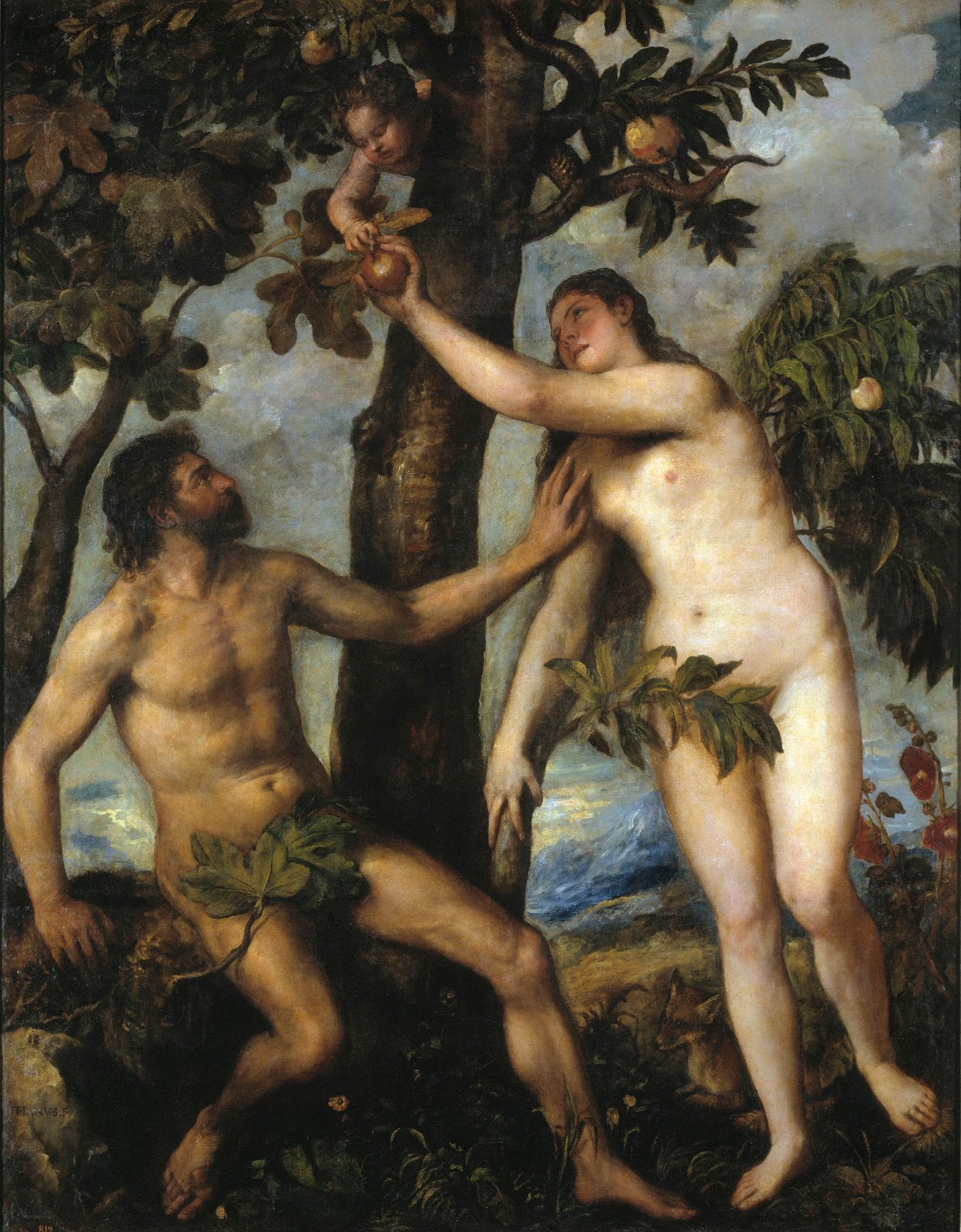
adam & eve- titian
1550
serpent w child face
saint sebastian- titian
1570
losing clarity bc he was losing his sight-
used fingertips to paint
flaying of marsyas- titian
1570
marsyas= part man, part goat
being skinned alive
red throughout composition
challenged apollo to a competition in playing their instruments
 to see who can seduce the people & animals but apollo is a God 
fig. 22-41
pieta- titan & palma II giovane
ca. 1570-1576, oil on canvas
broad brushstrokes, thick impasto
portrayed himself as st. jerome kneeling before dead Christ
ART & SOCIETY: WOMEN IN THE RENAISSANCE ART WORLD
-renaissance world was male dominated
-training required staying in a master's house, preventing women from being able to gain experience
-women were barred from drawing nude models
-some women surmounted the barriers & earned a good reputation (Sofonisba Anguissola, Lavinia Fontana, Properzia de' Rossi)
-renaissance women had great influence as art patrons
-one of the most important patrons: isabella d'este

ARTISTS ON ART: PALMA IL GIOVANE ON TITIAN
-important change in mid-16th century: adoption of canvas in place of wood panels
-titian established oil-based pigment on canvas as standard medium
-palma il giovane was titian's student
-in the last stages, titian painted more w his fingers than brushes

PROBLEMS & SOLUTIONS: HOW TO IMPRESS A POPE
-artists depended on commissions from churches, town councils, princes, wealthy merchants, etc.
-parmigianino became a leading figure among the "mannerists"
-he painted a self-portrait in an unconventional format to impress pope clement VII

mannerism (1520-1600):
  • prime feature of mannerist art is artifice
  • less inclined to disguise the contrived nature of art production
  • ambiguous space, departures from conventions, unusual presentations of traditional themes
  • leading mannerist architect: giulio romano
  • departure from compositions of earlier Renaissance
  1. attenuation of figures (elongation)
  2. crowded compositions
  3. unbelievable space (ambiguous)
  4. incongruent colors
  5. illogical narratives
  6. disproportional heads (non-ideal) 
  7. emphasis on verticality
  8. unbridled emotions
  9. violated containment (non-closed)
fig. 22-42
entombment of Christ- Jacopo da Pontormo
1525-1528, oil on wood
Capponi Chapel, Florence, Italy
mannerism
instead of concentrating mass in the center, he left a void
the person underneath christ is on tip-toes & body folds in an unusual way
vertically stacked- looks like everyone is floating
fig. 22-44
Madonna with the long neck- Parmigianino
1534-1540, oil on wood
Baiardi Chapel, Parma, Italy
stylish elegance that was principal aim of Mannerism
small oval head, long & slender neck, attenuated hands, sinuous body
baby looks sickly
the column is holding nothing up
fig. 22-45
venus, cupid, folly, and time- bronzino
ca. 1546, oil on wood
cupid fondling mother, Venus
lascivious undertones to learned allegories
father time in the right corner- revealing "secret" under the "cape"
person behind cupid has syphilis?
fig. 22-48
last supper- tintoretto
1594, oil on canvas
imbued w emotional power, depth of spiritual vision
glowing venetian color schemes, dramatic lighting
more than just the 12 disciples w jesus- pulls focus from christ
ghost-like/angel figures
fig. 22-49
christ in the house of levi- paolo veronese
1573, oil on canvas
refectory of santi giovanni e paolo
superb color & majestic classical settings
his version of the last supper--> sacrilegious
easy to not see Christ
  • anachronistic: belonging to a period other than that being portrayed
PATRON'S VOICE: FEDERIGO GONZAGA, GIULIO ROMANO, & THE PALAZZO DEL TE
-patrons had a powerful voice in content & form of the artworks they paid for
-Gonzaga (duke of mantua) showered Giulio (painter/architect) w gifts & accepted Giulio's proposal to construct a grandiose palace when he had planned only to invest in a modest retreat
-giulio's mannerist divergences from architectural convention shows in the palazzo del te

reacting to my old videos ft. blendaaaaa.